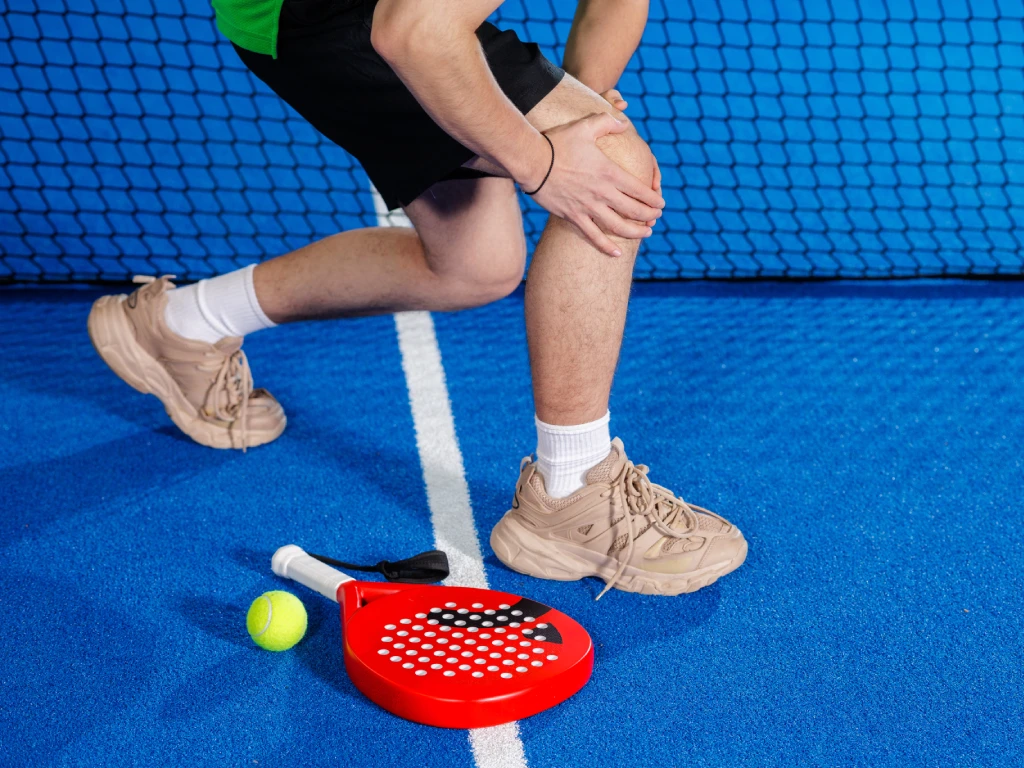
Whether you're lifting weights at the gym, chasing a ball across the pickleball court, smashing a shuttle in a badminton game, or enjoying a weekend tennis match, your knees work harder than you may realise.
You finish a challenging leg workout feeling strong. A few days later, you're stretching to return a shot during your pickleball match. The next morning, your knees feel stiff, sore or slightly swollen.
So, what caused it? Was it the heavy squats? The repeated lunges? The sudden stops and quick changes in direction? Or did you simply ask too much of your knees in one week?
For many active adults, it's difficult to tell the difference between normal post-exercise soreness and a knee problem that needs attention.
Understanding why your knees hurt is the first step towards recovering well and continuing to enjoy the activities you love.
What Do Squats and Court Lunges Have in Common?
Although squats in the gym and the quick lunges, pivots and changes of direction seen in pickleball, badminton, padel and tennis look very different, they place many of the same demands on your body.
Both movements require your hips, knees and ankles to work together while your muscles help control your balance, absorb force and push you back into position.
The biggest difference is how predictable the movement is.
During a squat
A squat is usually slow and controlled. You decide how deep to go, how fast to move and how much weight to lift.
During a squat:
- Both feet are usually planted on the ground.
- The movement is controlled and repetitive.
- The load comes from your body weight or additional weights.
- Your knees bend and straighten through a planned range of motion.
During pickleball, padel or tennis
Court sports are far less predictable. One moment you're standing still. The next, you're lunging sideways, stopping suddenly or changing direction to chase a ball.
During court sports:
- One leg often takes most of your body weight.
- Movements happen quickly and unexpectedly.
- Your body may twist while your foot remains planted.
- Sudden stops and changes of direction place extra stress on the knee.
This is why your knees may feel perfectly fine after leg workouts at the gym but become sore after a long rally on the court.
Are Squats and Lunges Bad for Your Knees?
Not necessarily, squats and lunges are not inherently bad for your knees.
In fact, they are movements your body performs every day. Sitting down, standing up, climbing stairs and picking something up from the floor all involve similar movement patterns.
When performed appropriately, squats and lunges can strengthen the muscles around the hips and knees, helping to improve stability and support for the joint.
Knee pain is more likely to occur when:
- You increase the weight too quickly or use incorrect posture.
- You perform more repetitions than your body is used to.
- You return to exercise after a long break.
- You suddenly play several games of pickleball or tennis without building up gradually.
- You have an existing knee condition or a previous injury.
The movement itself is rarely the problem. More often, your knees are simply being asked to do more than they're currently prepared for.
Why Might Your Knees Hurt During Squats or Court Sports?
Experiencing knee pain after a gym session or a pickleball match doesn't always mean you've injured your knee. In many cases, it's the result of your body adapting to a new level of activity or coping with more training than it's used to.
Several factors can contribute to knee discomfort.
1. You Increased Your Activity Too Quickly
Perhaps you started the week with heavy leg workouts at the gym before squeezing in a few pickleball matches over the weekend.
While your muscles may recover within a day or two, your joints, tendons and cartilage often need longer to adapt. Increasing your training volume or intensity too quickly can place extra stress on the knee.
2. Your Body Is Fatigued
The muscles around your hips, thighs and calves help absorb impact and keep your knees stable.
As these muscles tire, your knees may have to work harder during squats, lunges and sudden changes in direction. This can lead to discomfort, particularly towards the end of a long training session or match.
3. Your Movement Pattern Needs Improving
Technique can also influence how much stress passes through the knee.
During squats, for example, poor control or limited mobility may cause more load to be placed on certain parts of the joint. During court sports, repeated lunges, pivots and sudden stops require your knees to absorb force from multiple directions.
The goal isn't perfect technique, it's moving with good control and within a range that suits your body.
4. Your Hips and Ankles May Not Be Sharing the Load
The knee works as part of a chain.
If your hips lack strength or your ankles are stiff, your knees may end up taking on more of the workload during squats, lunges and court movements.
Improving hip strength, ankle mobility and balance can often reduce unnecessary stress on the knee.
5. You Have a Previous Knee Injury
Old injuries don't always disappear completely.
Previous meniscus tears, ligament injuries or cartilage damage can become noticeable again when activity levels increase or when returning to sport after a long break.
6. Repeated Court Movements Can Add Up
Sports such as pickleball and tennis involve far more than running from one side of the court to the other.
Players repeatedly squat into a ready position, lunge for low balls, stop suddenly and change direction throughout a match. These repetitive movements can place significant demands on the knees, particularly if you're new to the sport or playing for several hours at a time.
Over time, the repeated loading may irritate the kneecap, tendons or other structures around the knee, especially if your body hasn't had enough time to recover.
Muscle Soreness or Knee Pain? How Can You Tell the Difference?
After a challenging leg workout or an intense pickleball match, it's completely normal to feel sore. Your muscles may ache as they recover and adapt to the exercise, especially if you've increased your training or tried a new activity.
However, joint pain is different from muscle soreness. Knowing the difference can help you decide whether your knee simply needs more recovery time or whether it's worth having it assessed.
It may be normal muscle soreness if:
- Your thighs, glutes or calves feel tired after exercise.
- Both legs feel similarly sore.
- The discomfort starts a few hours after your workout.
- The soreness gradually improves over the next two to three days.
- There is no swelling, locking or feeling that the knee is unstable.
It may be more than muscle soreness if:
- The pain feels deep inside the knee.
- One knee hurts significantly more than the other.
- Your knee becomes swollen.
- Pain occurs every time you squat, lunge or climb stairs.
- Your knee catches, locks or gives way.
- The pain keeps returning after exercise.
- Walking or everyday activities become uncomfortable.
These symptoms do not always indicate a serious injury, but they shouldn't be ignored if they persist or continue to affect your activities.
Where Does Your Knee Hurt?
The location of your knee pain can sometimes provide clues about which part of the joint is under stress. However, pain alone cannot confirm the exact cause, so it's important to consider your symptoms together with how the injury happened.
1. Pain at the front of the knee
Pain around or behind the kneecap is common in people who experience knee pain during squats. It may also become noticeable when climbing stairs, getting up from a chair or sitting for long periods.
This type of pain may occur when the kneecap or surrounding tissues become irritated from repeated bending or increased training loads.
2. Pain on the inside or outside of the knee
Pain along the inner or outer side of the knee is often noticed after sports involving repeated lunging, pivoting or sudden changes in direction, such as pickleball or tennis.
It may be related to irritation of the ligaments, tendons or the meniscus, although a proper assessment is needed to identify the exact cause.
3. Pain at the back of the knee
Pain behind the knee may develop after repeated running, squatting or lunging. It can be linked to muscles, tendons or other structures around the back of the joint.
4. Pain after a sudden twist
A sharp pain following an awkward landing, pivot or twisting movement deserves closer attention, especially if it's accompanied by swelling, instability or difficulty putting weight on the leg.
These symptoms may suggest an injury that requires further assessment.
Noisy Knees Are Not Always Injured Knees
Have you ever heard your knees click or pop during a squat?
While the sound can be worrying, it isn't always a sign that something is wrong.
In many cases, painless clicking occurs as tendons move over the joint or tiny gas bubbles are released within the joint fluid. This is common and usually isn't a cause for concern.
However, clicking should be assessed if it occurs together with:
- Pain
- Swelling
- Locking or catching
- Reduced range of movement
- A feeling that the knee gives way
The sound itself is often less important than the symptoms that accompany it.
Gym Squats vs Court Lunges: Which Is Harder on the Knees?
Both gym workouts and court sports challenge your knees, but they do so in different ways.
During leg workouts at the gym, movements such as squats are usually controlled and repetitive. You decide the weight, speed and depth of each repetition.
In contrast, sports like padel or tennis involve constant changes in direction, sudden stops, twisting movements and quick lunges that require your knees to react instantly.
| Movement | What challenges the knee? |
|---|---|
| Bodyweight squat | Repeated bending and standing |
| Weighted squat | Increased load through the joint |
| Deep squat | Greater range of movement |
| Forward lunge | One leg supports most of the body weight |
| Side lunge | Balance and sideways control |
| Sudden stop | Rapid deceleration |
| Pivot | Twisting forces through the knee |
| Long rally | Fatigue and repeated loading |
Rather than asking which activity is worse, a better question is whether your body is prepared for the demands of that activity.
Increasing intensity gradually allows your muscles, tendons and joints time to adapt, reducing the risk of overuse injuries.
Is my technique wrong?
There isn't one "perfect" squat or lunge that suits everyone. Factors such as your height, flexibility, strength, mobility and previous injuries all influence how you move.
Instead of trying to copy someone else's technique, focus on moving with good control and within a range that's comfortable for your body.
Some simple principles include:
- Move slowly and with control.
- Let your hips, knees and ankles work together.
- Increase weights and training intensity gradually.
- Avoid pushing through sharp or recurring pain.
- Give your body enough time to recover between intense training sessions.
For pickleball, padel and tennis players, it's equally important to develop good movement control on the court. Being able to slow down, change direction and recover your balance efficiently places less unnecessary stress on the knees.
Remember, good technique doesn't guarantee you'll never experience knee pain. Likewise, experiencing pain doesn't always mean your technique is poor. Often, the biggest factor is whether your body has had enough time to adapt to the demands you're placing on it.
When Should You See an Orthopaedic Specialist?
Most episodes of knee pain improve with rest, activity modification and time. However, some symptoms should not be ignored.
You should seek medical attention if you experience:
- Sudden or severe knee pain.
- A popping sensation at the time of injury.
- Rapid swelling after a fall or twist.
- Difficulty standing or walking.
- Your knee locks or cannot fully straighten.
- Your knee repeatedly gives way.
- A noticeable change in the shape of your knee.
It is also worth arranging an assessment if:
- The pain keeps returning after exercise.
- Swelling does not improve.
- Your knee feels stiff or movement becomes limited.
- Everyday activities such as climbing stairs become painful.
- You are unable to return to the gym or sports comfortably.
Early assessment can help identify whether your symptoms are related to overuse, cartilage damage, ligament injury or another knee condition.
What Could Treatment Involve?
The good news is that many knee conditions can be managed without surgery.
Treatment depends on the underlying cause, the severity of your symptoms and your activity goals.
For many people, treatment may include:
- Temporary modification of activities.
- Physiotherapy to improve strength and movement.
- Medication for pain relief, where appropriate.
- Pain-relieving or anti-inflammatory injections in selected cases.
If there is a more significant injury, further treatment may sometimes be recommended, including:
- Arthroscopic (keyhole) knee surgery.
- Cartilage repair or cartilage regeneration procedures.
- Joint reconstruction or joint replacement for advanced joint damage.
If you've been diagnosed with cartilage damage, one of the first questions you may ask is about knee cartilage damage recovery time. Recovery varies depending on the severity of the injury and the type of treatment required. While some people improve with rehabilitation alone, others may require surgical treatment followed by several months of recovery before returning to higher-impact activities.
Your treatment plan should always be tailored to your condition, lifestyle and the activities you hope to return to.
How Can You Help Your Knees Keep Up?
Whether you're training for stronger legs or playing your weekly pickleball match, a few simple habits can go a long way in protecting your knees.
1. Build-up gradually
Avoid making large jumps in weight, training frequency or playing time. Giving your body time to adapt helps reduce the risk of overuse injuries.
2. Warm up before you exercise
A proper warm-up prepares your muscles and joints for movement. Dynamic exercises that activate the hips, thighs and calves can help your body move more efficiently.
3. Strengthen more than just your knees
Strong glutes, quadriceps, hamstrings and calves all work together to support the knee. A balanced strengthening programme is often more effective than focusing on one muscle group alone.
4. Allow enough recovery
It's tempting to fit in the gym, pickleball and a weekend run all in the same week. However, recovery is just as important as training, especially if you're increasing your activity level.
5. Listen to recurring pain
Occasional soreness after exercise is common.
Pain that keeps returning in the same area, affects your performance or interferes with everyday activities deserves attention rather than being ignored.
Keep Moving, But Don't Ignore the Signs
Squats, running, pickleball, padel and tennis are all excellent ways to stay active, build strength and improve overall fitness. None of these activities is automatically harmful to your knees.
In many cases, knee pain after exercise is simply a sign that your body needs more time to recover or adapt to increased activity. Understanding what's causing your symptoms is the first step towards effective treatment and preventing future injuries. Whether it's a minor overuse problem, a meniscus injury, cartilage damage or another knee condition, early assessment can help you return to sport safely and confidently.
At Island Orthopaedics, Dr Leon Foo manages a wide range of knee conditions, from sports-related injuries and cartilage damage to more complex joint disorders. As a fellowship-trained orthopaedic surgeon in Cartilage Regeneration and Joint Reconstruction, he provides personalised treatment plans to help patients relieve pain, restore function and return to the activities they enjoy.
If knee pain is affecting your workouts, your time on the pickleball court or even everyday activities, don't ignore the signs. Seeking medical advice early may help prevent a minor problem from becoming a more significant injury.
Frequently Asked Questions
Are squats bad for your knees?
No. Squats are a natural movement that most people perform every day. When performed within your body's capabilities and with appropriate training progression, they can help strengthen the muscles that support the knee.
Why do my knees hurt after playing court sports?
Pickleball, badminton, padel and tennis involve repeated lunges, sudden stops, twisting movements and changes in direction. These movements can place extra demands on the knees, particularly if you've recently increased your activity or returned to sport after a break.
Should I stop exercising if my knee hurts?
Not always. Mild discomfort may improve with temporary changes to your activity, such as reducing training intensity or allowing more recovery time. However, sharp pain, swelling, locking or instability should be assessed before continuing to exercise.
Does clicking during squats mean something is wrong with my knees?
Painless clicking is common and is not usually a sign of injury. However, if clicking occurs together with pain, swelling, locking or reduced movement, it's worth having your knee assessed.
When should I see an orthopaedic specialist for knee pain?
You should consider seeing a specialist if your knee pain keeps returning, affects your daily activities, follows a twisting injury, or is accompanied by swelling, locking, instability or difficulty walking.
Related Doctor

Dr Leon Foo
Consultant Orthopaedic Surgeon MBBS (Singapore), MRCS (Edinburgh), Mmed (Ortho) (Singapore), FRCS (Ortho) (Edinburgh)Related Clinic

Island Orthopaedics (Mount Elizabeth Novena)


Related Articles
Your Hands Work Hard: Common Hand and Wrist Problems to Know
September 01, 2026
Why ACL and Meniscus Injuries Can Keep Athletes Out for Months
July 15, 2026